
ARTICLE 05 / POWER INFRASTRUCTURE & PRODUCT STRATEGY
Where will the technology create measurable customer value?
The next power-conversion question
Conventional transformers are among the most successful products in electrical engineering. They are efficient, robust and understood by the people who specify, install and maintain them. So why are companies investing in solid-state transformers (SSTs)?
Because some of the fastest-growing electrical applications need more than a voltage change. AI data centers are considering higher-voltage DC distribution; charging sites need tightly controlled power; and hybrid energy systems must coordinate multiple sources and loads. The relevant question is not whether SSTs are more advanced. It is whether their added functionality solves a problem worth paying for.
1. What changes inside an SST?
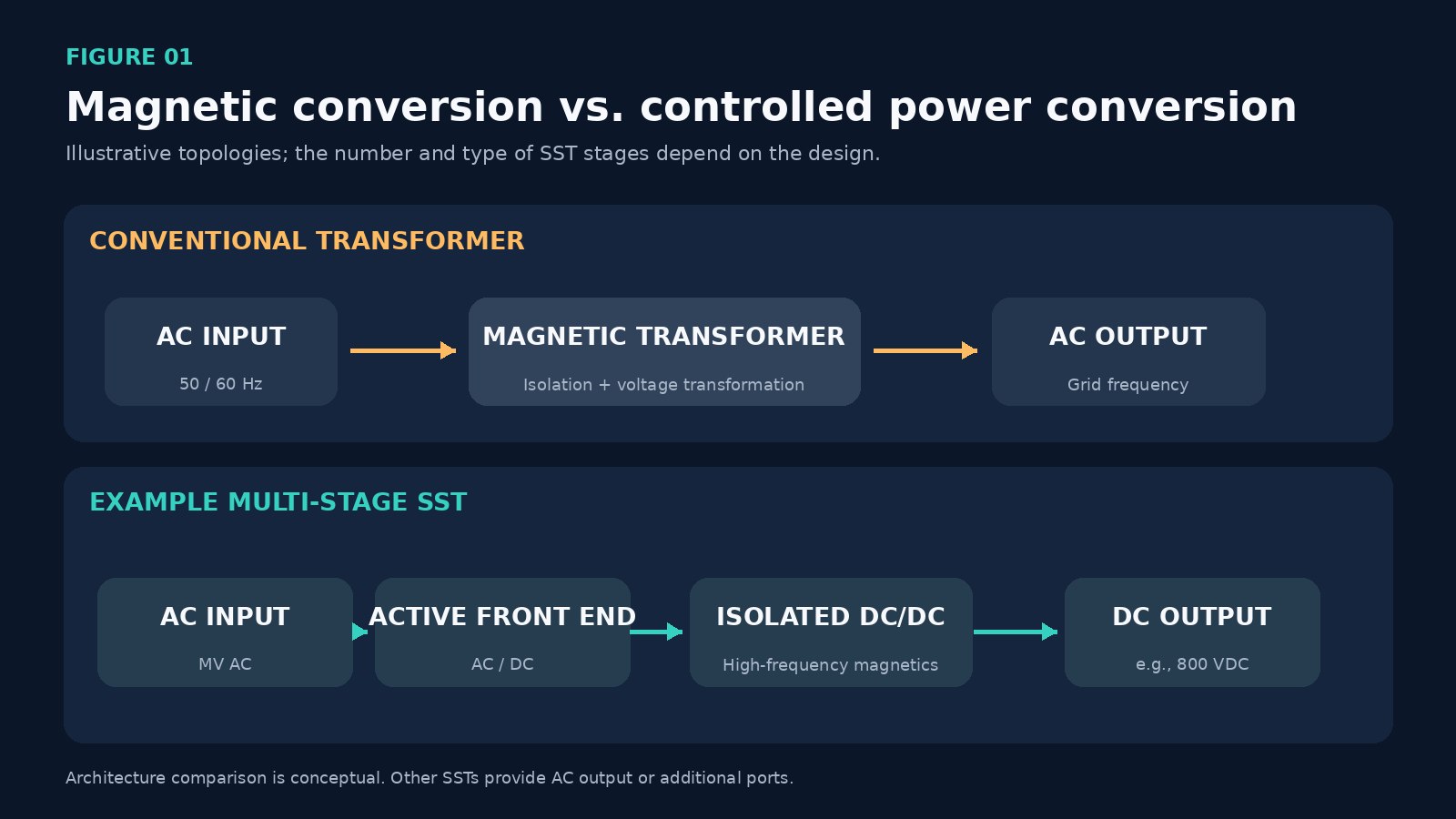
A conventional 50/60 Hz transformer changes voltage through magnetic induction. An SST adds actively controlled semiconductor conversion and typically a high-frequency isolation stage. Depending on the architecture, it can convert AC to DC, regulate voltage, manage bidirectional flow or connect multiple electrical interfaces.
That distinction matters commercially. A purchaser is no longer buying only magnetic hardware. They may be buying a combination of isolation, conversion, controls, monitoring and power management. But the SST must be compared with the complete conventional alternative— including rectifiers, switchgear, protection and controls—not with a transformer in isolation.
An architecture comparison also needs to identify which functions are actually integrated. For example, isolation may remain necessary even when conversion stages are consolidated. Product teams should document the electrical boundary, required redundancy and operating profile before comparing designs.
2. Why the market is paying attention
Silicon-carbide switches, improved high-frequency magnetic designs and digital control have made higher-power converter architectures more practical. Simultaneously, power distribution constraints are becoming more visible in fast-growing installations.
In August 2026, Siemens and Maschinenfabrik Reinhausen announced a joint development effort for an SST connecting to up to 36 kV and providing 800 VDC for AI data centers. It is a useful indication of industry direction, but a planned product and commercial deployment are not the same thing.
Importantly, 800 VDC is a distribution architecture, not proof that every site requires an SST. Conventional transformer-plus-rectifier solutions can also feed DC systems. The SST must earn its place through documented performance or integration benefits.
This also makes timing central to strategy. An equipment supplier may see growing design activity well before customers finalize specifications, approved vendor lists or lifecycle-support requirements. The difference between a market signal and an executable order book can be several qualification cycles.
3. Engineering performance is a system problem
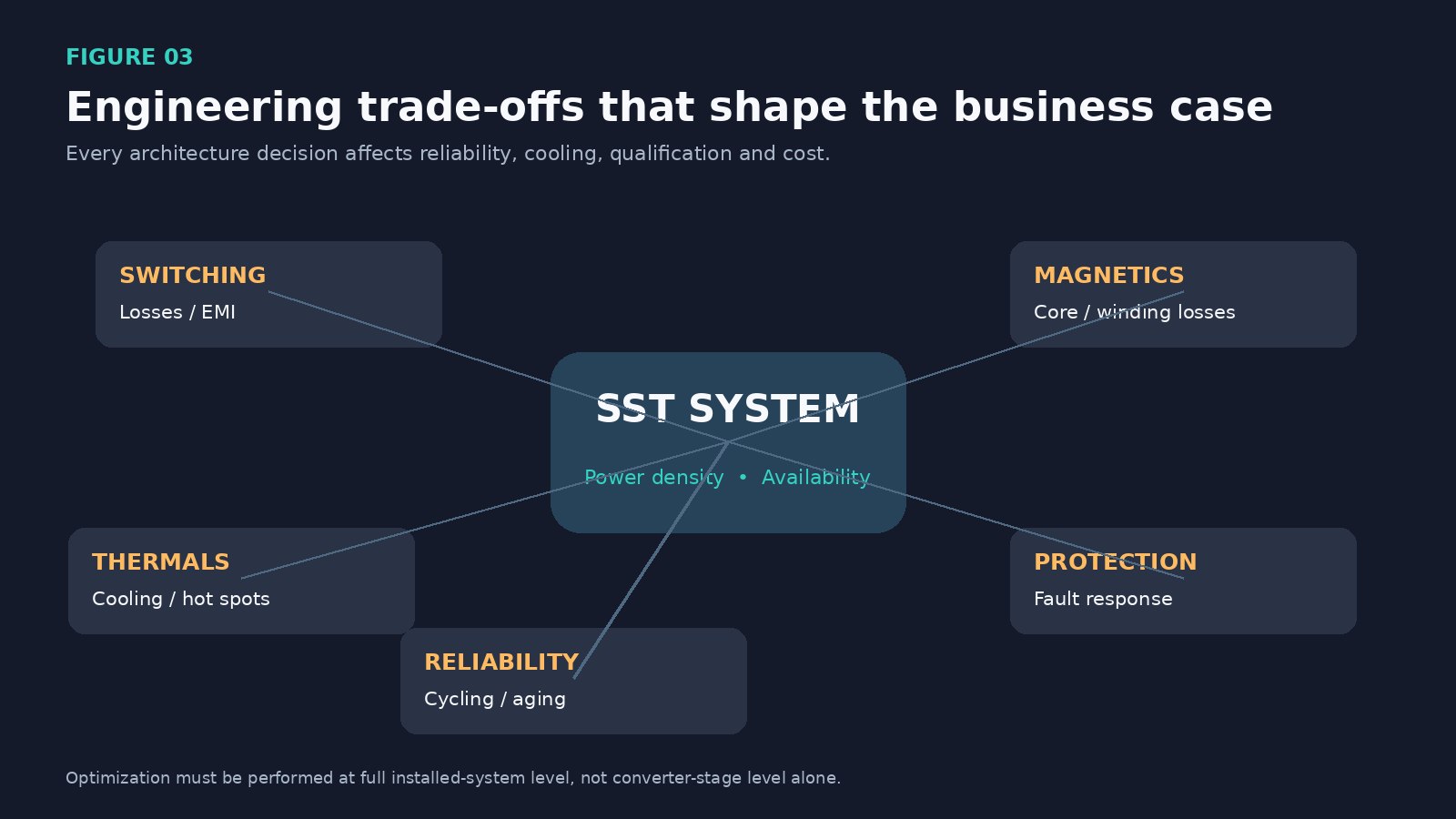
Higher switching frequency can shrink magnetic components, but it can also increase semiconductor switching loss, magnetic loss and electromagnetic-interference challenges. Greater power density creates heat-removal and packaging constraints. Semiconductor protection must respond quickly, while grid interfaces still need appropriate fault coordination.
Reliability deserves particular attention. The conventional transformer has an extensive service record; an SST contains switching devices, capacitors, sensors, gate drives and control systems that must all survive real operating conditions. An attractive laboratory efficiency number says little about serviceability, availability or full-system loss until the operating boundary is defined.
For product leaders, these technical choices become commercial inputs: warranty reserves, field service, certification schedules, spare parts, supplier strategy and the cost of proving long-term performance.
Component commonality is particularly important in modular platforms. Standard power modules may improve purchasing leverage and repairability, yet common parts can create common-mode failure exposure. The architecture has to balance standardization with fault containment and maintainability.
4. The economics must be measured at the right boundary
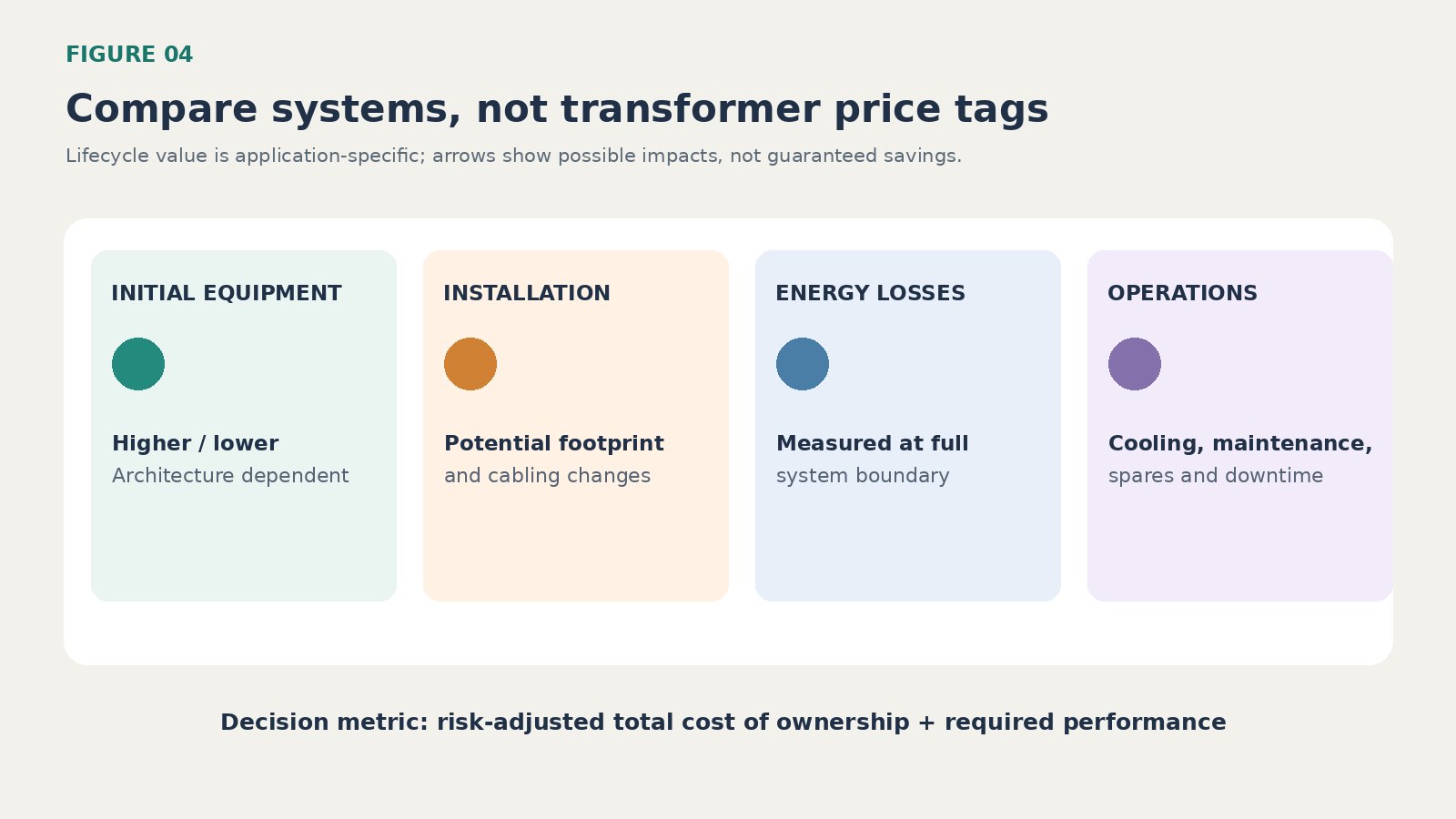
Imagine comparing a conventional transformer plus downstream power converters with an integrated SST-based power system. The SST might reduce conversion hardware, distribution complexity or footprint. It might also need more cooling, redundancy, specialized maintenance or costly power modules.
Total cost of ownership must capture acquisition, balance-of-system equipment, installation, electrical losses, maintenance, downtime risk and end-of-life replacement. Even a small verified efficiency gain can matter at high utilization: one percentage point of a continuously delivered 10 MW load corresponds to about 876 MWh over a year, or roughly $87,600 at an illustrative $0.10/kWh. This is a calculation, not a claimed SST saving.
Without a common measurement boundary, comparisons can make one solution appear better simply because its associated costs sit elsewhere in the system.
Customers also purchase risk reduction. A promising financial model can fail procurement review if the installer cannot qualify the protection scheme, the operator lacks trained technicians or the supplier cannot commit to replacement modules over the required service life.
5. Choose a first market, not every market
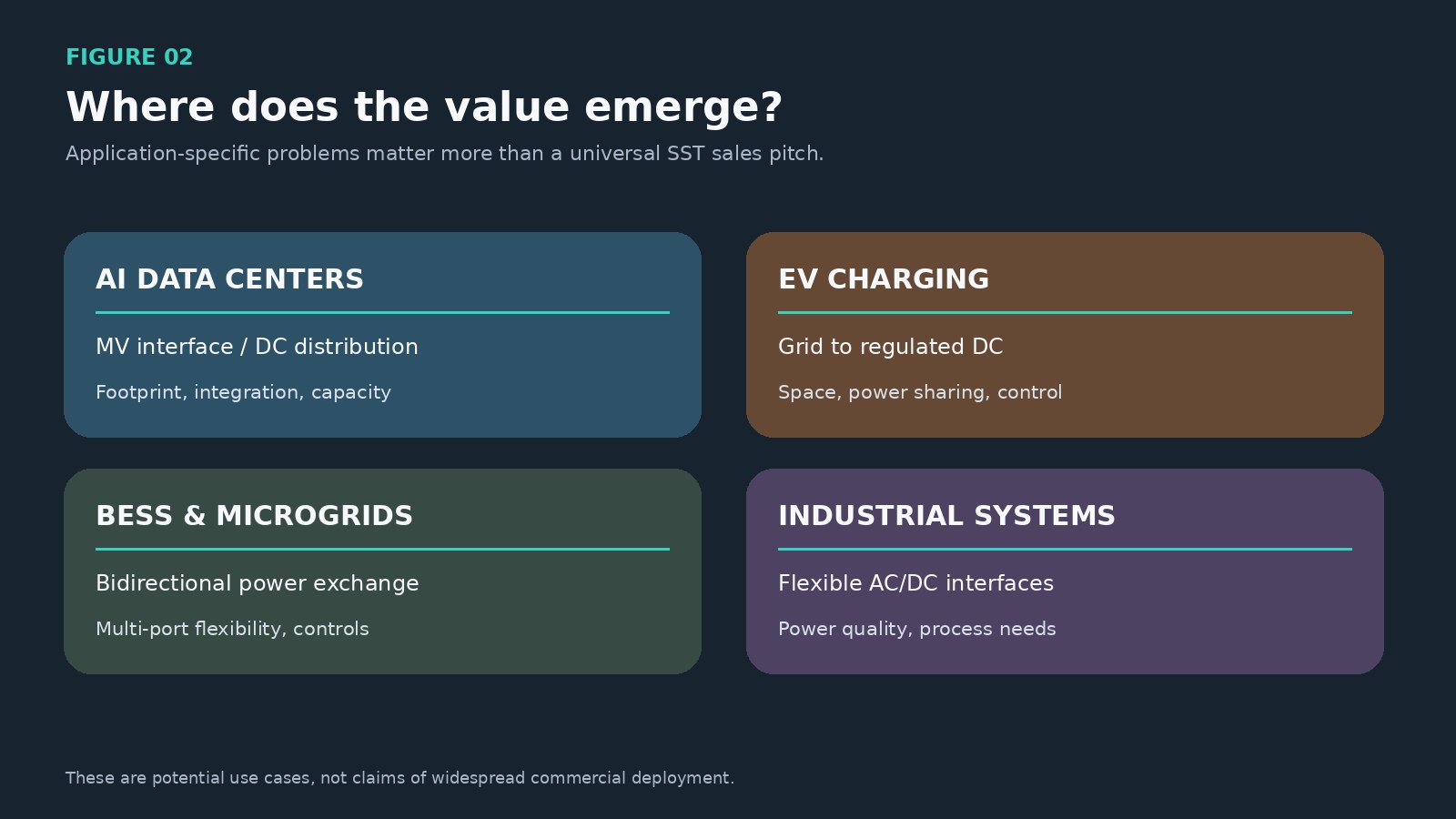
It is tempting to position SSTs across utility distribution, EV charging, storage, microgrids and data centers at once. That would create a large addressable-market slide—and potentially an unfocused product roadmap.
Commercialization should start with the customer constraint. Is floor space unusually expensive? Does the application need regulated DC at a medium-voltage interface? Are bidirectional power flows essential? Can the buyer quantify the value of power-quality controls, deployment speed or simpler system integration?
A utility network with long asset-life expectations may assess an SST very differently from a specialized high-density facility. Neither is automatically the better market. The promising first market is the one where the economic value is measurable, qualification is achievable and a repeatable product can be sold.
6. The decision is to build, partner or pilot
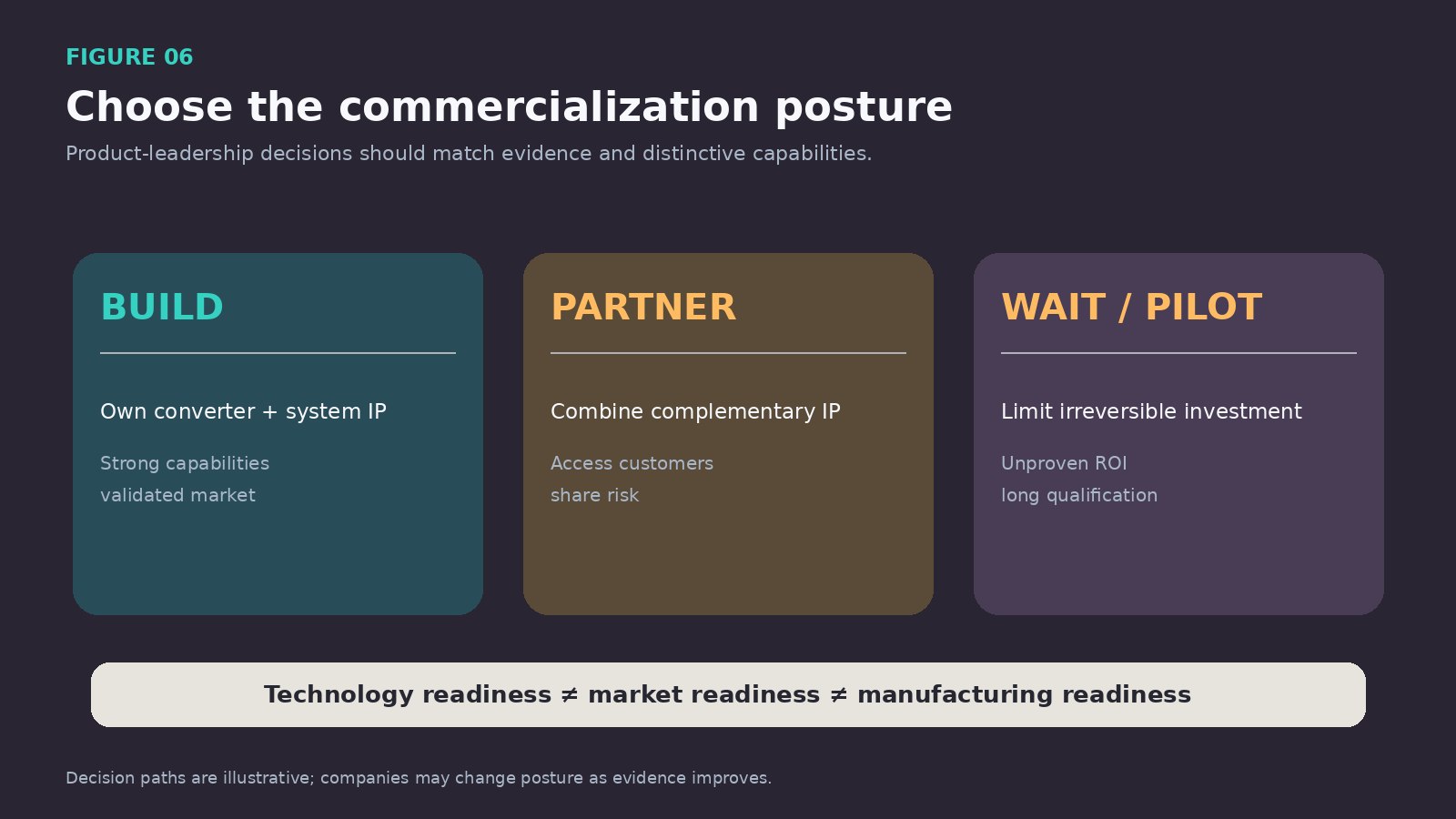
For established equipment manufacturers, SSTs present a capability decision as much as a technology decision. A magnetic-component company may excel at insulation and high-frequency magnetics. A power-electronics company may own converter topology and controls. An integrator may understand the customer architecture and service requirements.
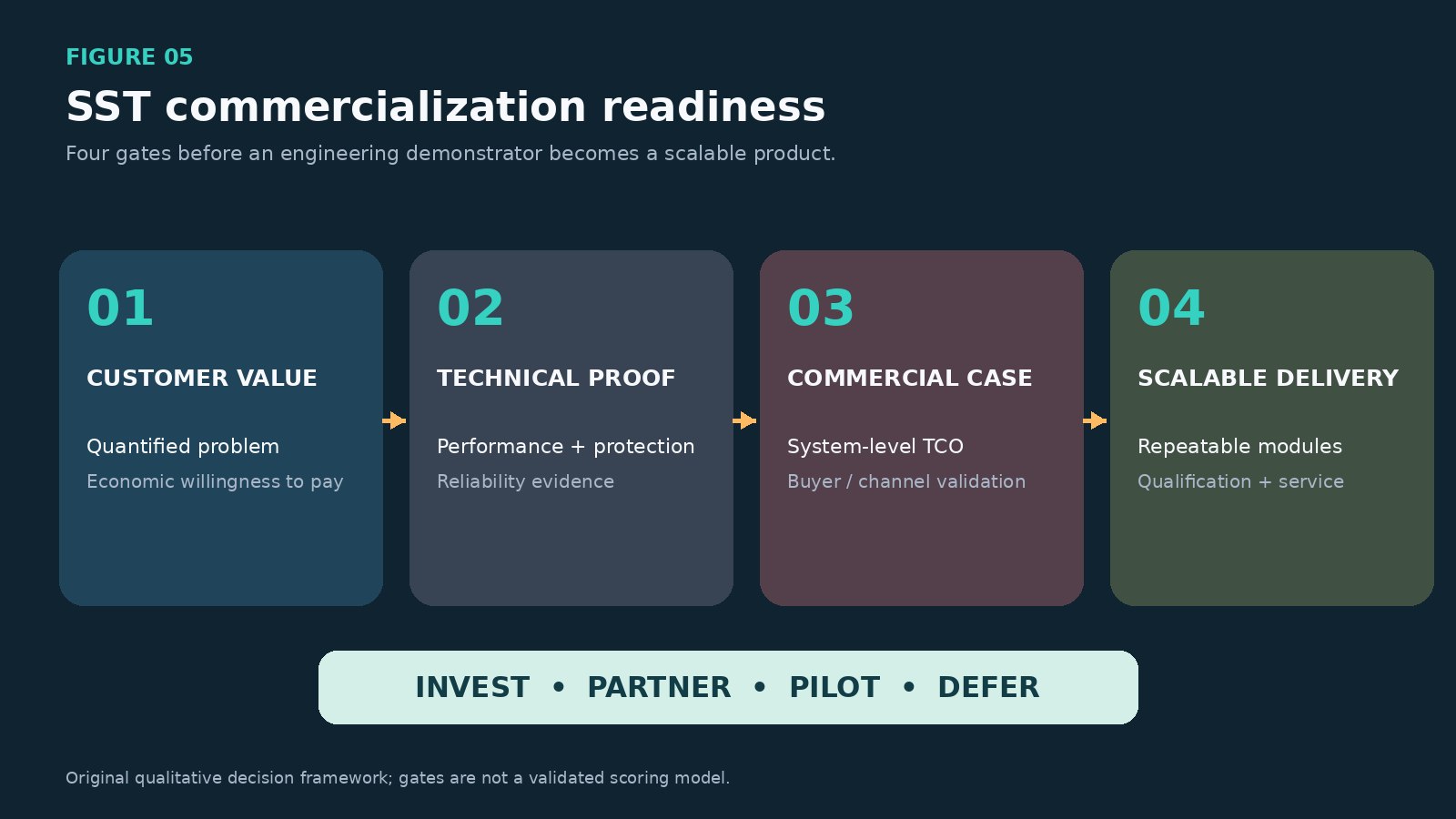
A credible roadmap should therefore pass four gates: quantified customer value, demonstrated technical readiness, a compelling whole-system business case, and scalable manufacturing plus service. Depending on the answers, the right strategy may be to build a platform, partner for missing capabilities, run a customer pilot or defer investment.
Modularity can help create repeatable product families, but uncontrolled application-specific variants can erase the benefits before meaningful volume is reached.
A disciplined launch plan should therefore focus on a small set of electrical ratings, documented interfaces, testable performance claims and a field-support playbook. Those commercial fundamentals rarely make headlines, but they frequently determine whether an attractive prototype becomes a profitable product line.
The product management takeaway
The question is not “When will SSTs replace transformers?” Conventional magnetic transformers will remain the practical choice in many applications for years to come.
The more useful question is: where does actively controlled power conversion create enough additional customer value to justify added complexity, risk and cost?
The winning company may not be the first with an impressive prototype. It may be the one that proves an application-level return, designs a serviceable platform and delivers it repeatedly at commercial scale.
A question for the industry
Which market do you expect to establish the first repeatable, high-volume SST business case: AI data centers, charging infrastructure, industrial microgrids or utility distribution?
