
800 VDC Is Coming to AI Data Centers. What Should Electrical Manufacturers Build—and What Should They Wait On? The next shift in data center power is also a test of product strategy: where to invest, what to standardize, and when the market is ready.
Imagine designing a new AI computing hall. You have the servers. You have the cooling plan. The utility connection is being arranged. But between the incoming power and the processors sits a problem that is becoming harder to ignore: moving enormous amounts of electricity into a very small space.
As AI racks get denser, cables, busways, power converters, heat, and equipment space become part of the computing conversation. Some of these challenges used to sit quietly in the background. Now they can influence what a data center can actually deploy.
That is why 800-volt direct current (800 VDC) has moved from a technical discussion into the product roadmaps of major infrastructure companies.
NVIDIA, Google, and Microsoft are working through the Open Compute Project (OCP) to align around open 800 VDC requirements. The initiative already includes a broad supplier ecosystem. It is a meaningful signal—but it is not a guarantee that every data center will suddenly become a DC facility. [1][2]
For electrical equipment manufacturers, I think the more useful question is this: where will customers need help first, and which of those problems are worth building a product business around?
Why the voltage matters—and why it isn’t the whole story The attraction of higher-voltage DC starts with a simple relationship: for the same power, higher voltage means lower current.
Take an idealized 1 MW DC load. At 400 V, it requires about 2,500 A. At 800 V, it requires about 1,250 A. That difference can matter enormously when engineers are deciding how to route conductors, manage losses, and fit equipment around a crowded row of compute racks.
Of course, real installations are not that simple. The outcome depends on distribution distance, conversion stages, conductor design, electrical protection, cooling, and equipment efficiency. An 800 VDC label does not automatically translate into a lower-cost or more reliable system.
Still, it opens a practical design option for power densities that are becoming difficult to serve with lower-voltage distribution alone.
And this is where I see an important distinction: the industry is discussing a new power architecture, not merely a different output-voltage specification.
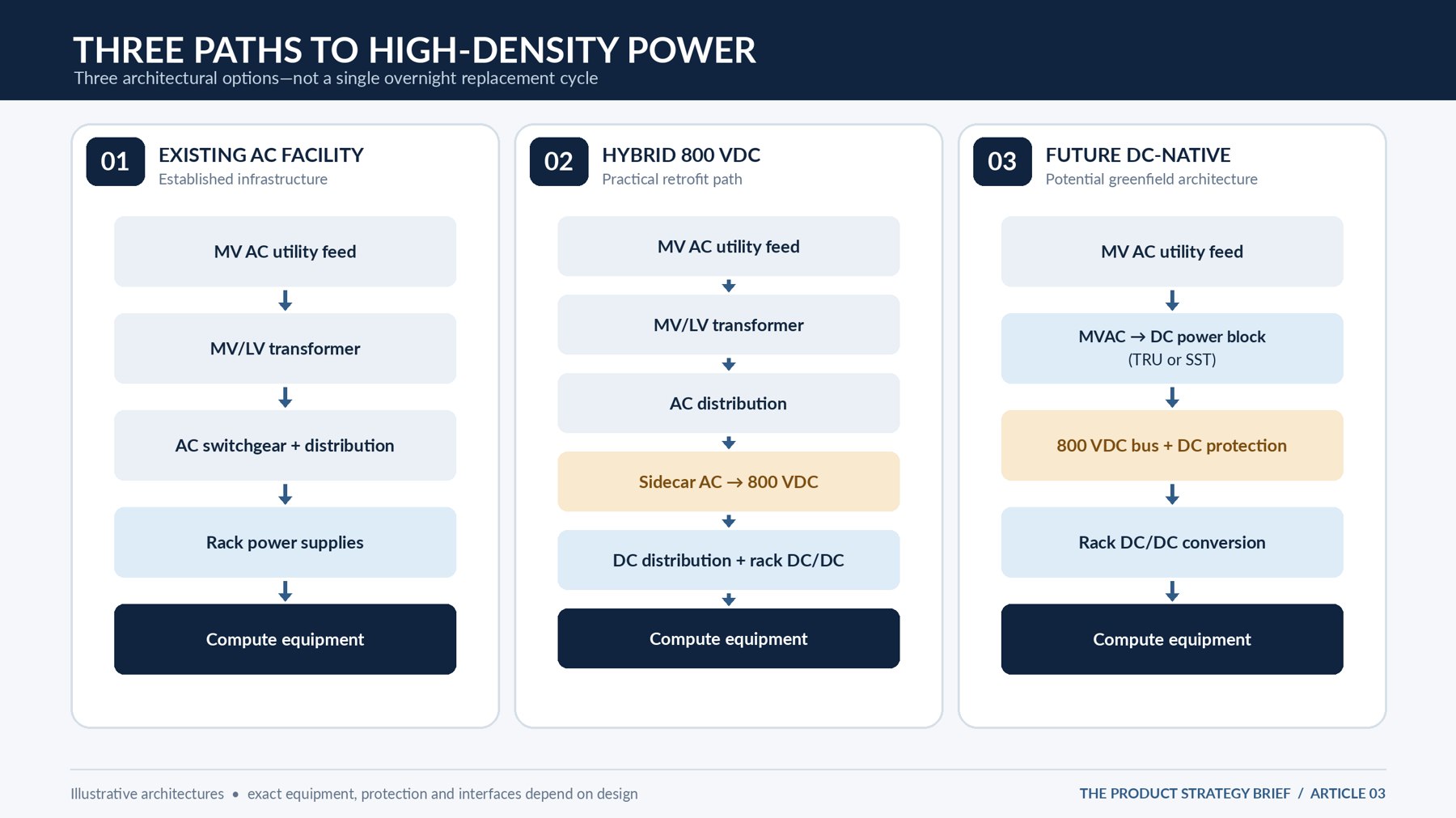
There won’t be one overnight switch from AC to DC The most useful way to understand the transition is to look at three possible facility paths.
Today’s AC-based approach continues to bring medium-voltage AC into a facility, step it down through transformers, and distribute AC toward the IT equipment. Power supplies and converters handle the final steps required by the computing hardware.
A hybrid 800 VDC approach keeps much of that upstream AC infrastructure. A dedicated power rack—or sidecar—converts incoming AC to a higher-voltage DC supply close to the IT racks. This is an attractive early path when existing facilities have sufficient electrical capacity and physical space. OCP explicitly describes this as a way to add DC distribution without rebuilding the entire upstream system. [1]
A future DC-native approach could convert medium-voltage AC directly into an 800 VDC backbone using integrated transformer-rectifier units or solid-state-transformer-based equipment. That could reduce some intermediate conversion stages and make it easier to integrate DC-side storage, but it brings different protection, installation, and operating requirements. [1][2]
These paths will coexist. A retrofit project, a newly built AI campus, and a conventional enterprise data center do not have the same economics or constraints. Manufacturers that treat all three as one market risk building the right technology for the wrong customer.
The opportunity looks different depending on what you make Consider a transformer manufacturer. The headline might sound threatening: if more equipment distributes DC, will the industry need fewer transformers?
I would be cautious with that conclusion. Most facilities still receive AC power from the grid. Transformers and medium-voltage distribution equipment remain part of the system, even if conversion moves closer to—or farther from—the IT rack. What may change is the location, configuration, and integration of that equipment.
For a power electronics company, the opportunities are more direct: high-density AC/DC conversion, efficient DC/DC stages, controls, modular power racks, and thermal management. But the challenge is not simply achieving impressive efficiency in a laboratory. The equipment has to run continuously, manage changing loads, be serviceable, and fit the customer’s preferred architecture.
For a magnetics supplier, there may be demand for specialized inductors and high-frequency transformer designs. Higher switching frequencies can improve power density in suitable topologies, but core losses, winding losses, insulation, heat, and electromagnetic compatibility do not disappear. A technically elegant component still has to be manufacturable and cost-effective.
For protection, distribution, and monitoring suppliers, the transition could be particularly interesting. DC fault interruption behaves differently from conventional AC protection. Converter-
fed systems can have fast, transient fault contributions that complicate conventional assumptions. Protection coordination, connectors, busways, isolation, and monitoring become core architecture decisions—not accessories added at the end. Schneider Electric’s 2026 analysis emphasizes why DC arc-flash assessment needs architecture-specific treatment. [3]
The opportunity is real in each category. The product roadmaps should not look identical.
A prototype is not a commercial product line This is the part of the 800 VDC discussion I find most interesting from a product management perspective.
It is relatively easy to put a promising new technology on a roadmap. It is much harder to answer the questions that follow.
Which interface will customers standardize on? What needs third-party certification? Who owns fault coordination when products from several vendors share a DC bus? Can field technicians maintain the equipment safely? How many variants will sales teams request before the factory can produce the first standard unit?
Those decisions determine development cost, qualification time, reliability risk, and ultimately profitability.
OCP’s work is important for precisely this reason. Its July 2026 solid-state transformer specification was published as version 0.3, while the broader group continues working on shared requirements, safety, and interoperability. That is progress, but manufacturers should treat evolving specifications as a design input to monitor—not evidence that every interface is finalized. [1][2]
From my experience in transformer and magnetic-component product management, a familiar risk stands out: customization can quietly turn a promising product platform into a collection of one-off engineering projects.
Imagine three major customers asking for essentially the same converter—but with different protection interfaces, monitoring protocols, cooling arrangements, and packaging. Without a platform strategy, the manufacturer could end up maintaining three designs, three qualification paths, and three supply-chain problems.
Common building blocks with controlled options are not as exciting as a breakthrough prototype. They are often what makes scalable delivery possible.
Four decisions I would put on the product roadmap If I were evaluating 800 VDC opportunities for an electrical equipment portfolio, I would organize the discussion around four decisions.
1. Where can we genuinely compete?
Start with the customers and the problem, not the technology headline. Are we best positioned to improve existing AC-to-DC power racks, develop advanced magnetics, supply protection equipment, or participate in future medium-voltage conversion? What capabilities do we already have that competitors would find difficult to replicate?
2. What should we build, and where should we partner?
Not every valuable capability should be developed in-house. A manufacturer with strong magnetic design and production skills may need a power semiconductor or control-software partner. A power electronics OEM may need an established protection supplier. The goal is an offering customers can qualify, not the longest possible list of internally developed technologies.
3. When should we commit to scale?
I would separate early architectural work from a full commercial launch. Validate customer requirements first. Build test platforms next. Prove protection, integration, safety, and reliability at system level. Expand production only when the target configuration and actual demand justify it. That sequence preserves learning without locking the factory into a design too early.
4. How will customers measure value?
Efficiency matters, but so do installed cost, space, service access, system availability, maintainability, and expansion flexibility. A component that is 0.5% more efficient may still be a poor choice if it makes maintenance complicated or introduces qualification risk. Conversely, a higher-priced solution can win if it reduces total system cost or accelerates deployment.
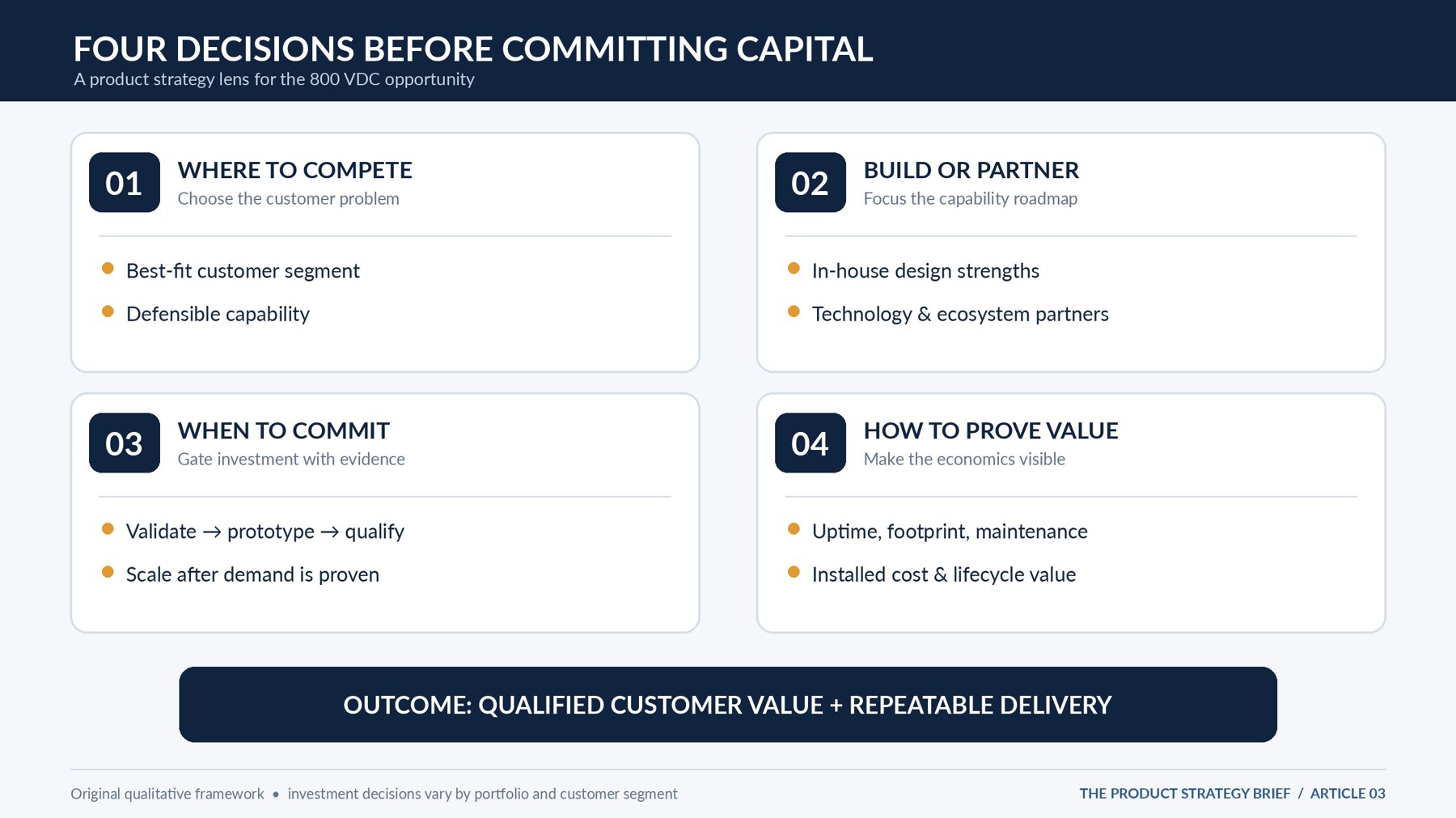
These four questions sound straightforward. In practice, they help separate a technology trend from a portfolio investment case.
The best opportunity may be solving what others overlook A lot of attention will naturally go to the biggest announcements: new power racks, high-density converters, and direct medium-voltage-to-DC systems.
But commercial success may depend on less visible pieces—clear interfaces, validated protection schemes, repeatable manufacturing, service procedures, and system-level test capability.
Those are also places where established electrical manufacturers can have an advantage. They already understand the realities of industrial qualification, field reliability, long supply chains, and scaling production beyond a successful prototype.
The timing matters. As of late 2026, suppliers are developing 800 VDC equipment and common requirements are advancing, while operators are still evaluating how and where to deploy these architectures. NVIDIA describes near-term hybrid power racks and longer-term DC-native facilities; Vertiv likewise expects multiple architectures to coexist. [2][4]
That creates room for disciplined investment—not an excuse to wait indefinitely, and not a reason to launch every possible product at once.
My takeaway I do not think the most important question for electrical manufacturers is, “Do we have an 800 VDC product yet?”
I would ask three harder questions: Which customer problem are we solving? Can we solve it better than others? And can we build and deliver that solution repeatedly at a profit?
800 VDC may change the shape of AI data center power systems. It will not change the fundamentals of good product management.
The manufacturers that combine engineering capability with sound portfolio choices, customer validation, and scalable product architecture will be better positioned than those chasing the voltage headline alone.
Where would you invest first: hybrid power racks, DC protection, medium-voltage conversion, or the controls and monitoring that connect everything together?
Sources and further reading
[1] Open Compute Project, Powering the Next Era of AI: How Google, Microsoft and NVIDIA Are Standardizing and Accelerating the Industry Transition to LVDC (2026).
https://www.opencompute.org/news/powering-the-next-era-of-ai-how-google-microsoft-and-nvidia-are-standardizing-and- accelerating-the-industry-transition-to-lvdc/
[2] NVIDIA, Why Scaling AI Compute Performance Requires a New Power Architecture (August 11, 2026). https://blogs.nvidia.com/blog/800-vdc-power-architecture-ai-factory/
[3] Schneider Electric, Why Arc Flash Safety Analysis Is Critical to the Industry’s Shift to 800 VDC in AI Data Centers (August 20, 2026). https://blog.se.com/datacenter/2026/08/20/why-arc-flash-safety-analysis-is- critical-to-the-industrys-shift-to-800-vdc-in-ai-data-centers/
[4] Vertiv, From Rack to Data Hall: The Practical Path to 800 VDC (July 17, 2026). https://www.vertiv.com/en-us/insights/articles/blog-posts/from-rack-to-data-hall-the-practical-path-to-800-vdc/
Analysis and opinions are independent and based on publicly available information. Diagrams are conceptual and not installation or engineering specifications.
Originally published: https://www.linkedin.com/pulse/800-vdc-coming-ai-data-centers-what-should-electrical-pmp–3yifc/. Editorial version derived from the supplied final manuscript. Please confirm visual equivalence to the live publication before release.
