
The Hidden Cost of Transformer Customization: Why Product Platforms Could Become the Industry’s Next Capacity Lever The transformer industry needs more manufacturing capacity. But what if part of the solution is also changing how we design, configure, and manage our products?
By Chinmay Shah | Product Management • Energy Infrastructure • Product Strategy
Are we looking at the transformer shortage from every angle? Demand is growing. Utilities are upgrading aging infrastructure. Renewable energy projects continue to expand. Data centers are changing where and how electricity is consumed. Meanwhile, transformer manufacturers are dealing with familiar challenges: long lead times, limited production capacity, material availability, and pressure to deliver faster. Most conversations about these challenges focus on expanding factories, investing in equipment, securing raw materials, or strengthening the workforce. All of these are necessary. But I believe there is another question worth discussing: Are we making transformer manufacturing more complicated than it needs to be? After years of working across transformer engineering, manufacturing, and product management, I have come to appreciate how much complexity can hide behind what appears to be a relatively simple customer requirement. A small change requested by a customer may look straightforward from the outside. But inside a manufacturing organization, that change can affect engineering drawings, bills of materials, purchasing, production planning, testing, documentation, and delivery schedules. This is where I believe product architecture deserves a more prominent place in the industry’s capacity discussion.
1. The industry has a real supply challenge In its March 2026 distribution transformer webinar, the U.S. Department of Energy reported that distribution transformer demand had increased 41% since 2019. Lead times that were typically three to six months in 2019 had extended to one or two years, sometimes longer, in 2024—the latest year for which the department cited comparable data.
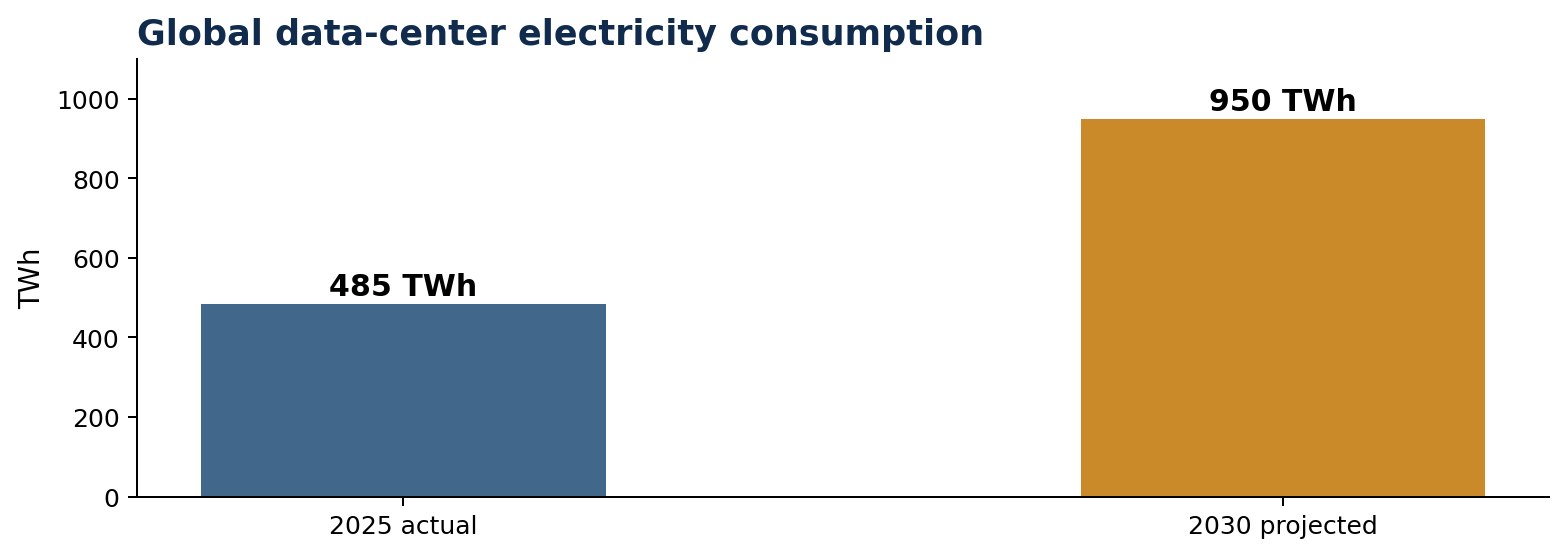
The International Energy Agency expects global data-center electricity consumption to grow from approximately 485 TWh in 2025 to 950 TWh by 2030. That is a significant expansion in an already constrained electricity infrastructure ecosystem.
Of course, growth in electricity demand does not translate directly into an equivalent percentage increase in transformer demand. Equipment requirements also depend on voltage, power capacity, network design, utilization, and location. Building additional capacity will take time and investment. So it makes sense to explore what can be improved within the manufacturing systems and product portfolios we already have.
2. The hidden cost of saying yes to every customization A transformer for a data center may have different requirements from one serving a solar installation, industrial facility, utility distribution network, or marine application. Customers may require specific voltage ratios, impedance, insulation systems, enclosures, dimensions, cooling arrangements, accessories, or certifications. Some of these differences are essential for performance, safety, and compliance. Others may simply reflect historical preferences or specifications that have been carried forward for years. The challenge starts when every difference is treated as a reason to create a new design. Imagine a manufacturer receiving three orders for transformers with similar kVA ratings and core construction. Each customer requests a slightly different enclosure, termination arrangement, or accessory package. That can mean different drawings, bills of materials, material codes, purchasing requirements, manufacturing instructions, and documentation. The real cost of customization is not always visible in the product’s selling price. Sometimes it appears elsewhere in the organization: engineering workload, inventory, changeovers, material planning, or manufacturing delays.
3. When product complexity starts consuming manufacturing capacity One of the most interesting findings from the U.S. Department of Energy is that there are more than 80,000 varieties of distribution transformers across the United States. That first number raises an important question: Do we really need that many variations, or have decades of individual specifications created more complexity than the market actually requires? Consider the impact of a new transformer variation across an organization. A new customer requirement can trigger new engineering drawings, supplier sourcing, production instructions, testing, and documentation. If we want to improve capacity, we should not only ask how many transformers a factory can produce. We should also ask how much unnecessary variation that factory is being asked to manage.
4. What if we built product families instead of individual products? The concept is straightforward: instead of treating every transformer as an independent design, identify the elements that can be shared across a family of products. Then allow variation only where it creates meaningful value. For example, within an appropriately defined transformer family, there may be opportunities to standardize certain mechanical components, enclosure designs, accessory interfaces, documentation structures, or manufacturing processes. Different ratings and applications may still require different electrical and thermal designs. A platform does not mean forcing every transformer to use the same core, winding arrangement, insulation system, or cooling method. Think of the difference between two approaches. In the first, every customer order starts with significant engineering customization. In the second, most requirements can be addressed through a
pre-engineered family of configurations, with custom engineering reserved for genuinely unique applications. Engineering teams can reuse validated design elements rather than repeatedly solving the same problems. Purchasing teams may consolidate materials. Manufacturing teams can benefit from repeatable processes. Sales teams can offer more consistent configuration choices. And product managers gain better visibility into portfolio profitability and complexity.
Product platforms do not automatically create additional physical production capacity. They can improve how effectively available capacity is used.
If the primary bottleneck is a constrained test bay, a critical raw material, or a shortage of skilled labor, platforming alone will not solve it. But if excessive design variation is consuming engineering hours, disrupting planning, or creating unnecessary changeovers, a platform strategy may make a meaningful difference.
5. Introducing the 4C Product Platform Framework Through my MIT Chief Product Officer program, particularly the study of designing product families, I have been thinking more deeply about how companies can balance variety with scale.
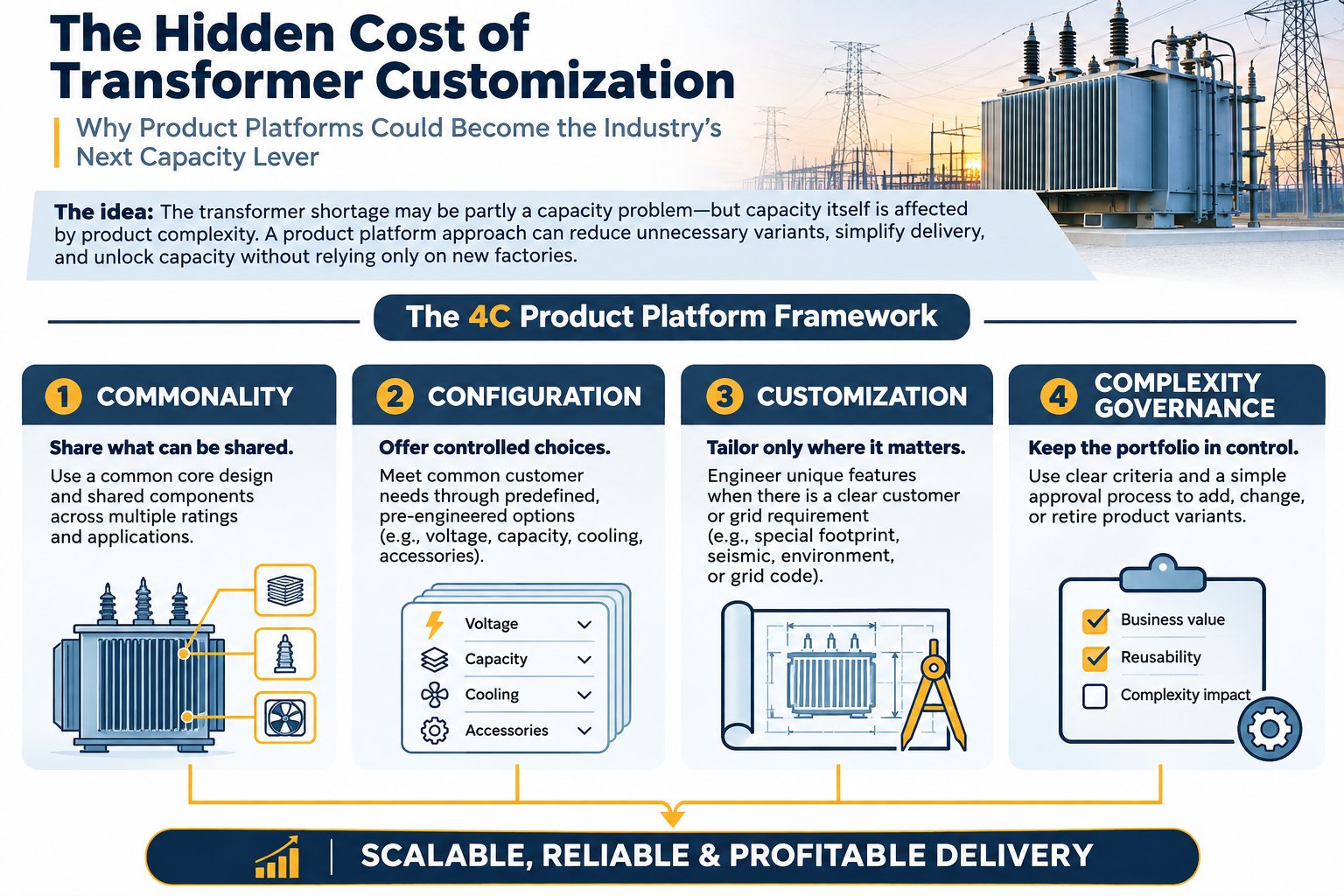
C1 — Commonality: Share what can be shared The first step is identifying what can be standardized across a product family without compromising performance or customer requirements.
C2 — Configuration: Offer controlled choices Customers still need flexibility. A platform should allow them to select from clearly defined, pre- engineered configurations wherever feasible. For example, standard accessory packages, termination arrangements, enclosure options, or approved design variants can provide flexibility without requiring a completely new engineering process each time. C3 — Customization: Tailor where it matters Not every requirement belongs in a standard configuration. A highly specialized industrial application may have unique thermal, environmental, mechanical, or electrical requirements. These differences may justify a fully engineered solution. The important question is whether the added complexity creates enough customer and business value to justify its cost. Customization should be a deliberate competitive choice, not simply the default response to every request. C4 — Complexity Governance: Keep the portfolio in control Even a well-designed product family can become complicated over time if every new customer requirement becomes a permanent addition to the portfolio. Someone needs to make decisions about which variants to introduce, reuse, consolidate, or eventually retire. That requires collaboration between product management, engineering, sales, supply chain, and operations. Without clear governance, today’s standard product family can become tomorrow’s collection of hundreds of loosely connected variants.
6. Standardization does not mean sacrificing customer value Whenever product standardization comes up, one concern usually follows: What if our customers really need something different? In the transformer industry, electrical ratings, insulation coordination, temperature rise, impedance, efficiency, environmental conditions, and applicable standards are not optional details. A standardized product that fails to meet a customer’s application requirements is not a successful product. This is why I do not see standardization and customization as opposing strategies. The objective should be to find the right balance. Perhaps 70% of a particular product family’s engineering architecture can be reused. Perhaps it is 40%, or perhaps very little can be reused across certain specialized applications. Those percentages are hypothetical, not industry benchmarks. They would need to be determined through technical and commercial analysis. In fact, a strong platform strategy can make customization more valuable. When standard features are clearly defined, engineering teams can focus their expertise on the genuinely difficult and differentiated customer requirements.
7. Where should transformer manufacturers begin? I would begin with one product family where demand is reasonably stable, product variation is high, and recurring engineering work is significant. Area Question worth asking Portfolio Which configurations account for most of our sales and profitability? Engineering How much design work is repeated across similar orders? Supply Chain How many components are unique to low-volume configurations?
Manufacturing Which product variations create the most disruption or changeovers? Customer Value Which customized features are truly important to purchasing decisions? I would also establish a baseline before making changes. Some practical measures could include engineering hours per order, percentage of reusable components, number of active variants, design-to- release time, manufacturing changeover time, and gross margin by product family. From a product management perspective, I would be particularly interested in comparing product complexity against actual revenue and profitability contribution. A low-volume product can still be strategically important and highly profitable. Similarly, a high- volume product is not automatically worth standardizing if doing so weakens its competitive position.
8. The bigger opportunity: Product management as a capacity strategy Product managers influence which products enter the portfolio, which features are offered, how products are positioned, where development resources are allocated, and which customer needs justify additional investment. Not by telling operations how to run a factory, but by helping the organization make better decisions about the products that factory is expected to produce. In 2025, a U.S. DOE-convened Distribution Transformer Working Group developed resources focused on component-family interchangeability and reducing transformer SKU complexity for utilities. The group presented this work publicly in March 2026.
9. My perspective: The next capacity investment may not always be a machine I strongly believe the transformer industry needs additional investment in manufacturing infrastructure. New factories, automated equipment, skilled workforces, and resilient supply chains are essential to support future demand. But before approving the next major capacity expansion, I think manufacturers should also ask: Have we made the existing system as scalable as it reasonably can be? Could we reduce unnecessary design variations? Could we share more components? Could we configure products instead of repeatedly engineering them from scratch? Could stronger portfolio governance improve predictability for manufacturing and customers? A large, highly engineered power transformer will not have the same opportunities for platforming as a repeatable distribution transformer family or a standardized industrial dry-type transformer portfolio. And product complexity is only one of several factors influencing today’s supply constraints. Still, I believe it is an opportunity worth evaluating. Because the future of transformer manufacturing will not be determined only by how much equipment manufacturers can install. It will also depend on how effectively they combine engineering expertise, product strategy, supply- chain capabilities, and manufacturing execution.
Sometimes, increasing capacity begins long before a product reaches the factory floor. It begins with the decisions we make when designing the product portfolio.
A question for industry leaders For those working in transformer manufacturing, electrical equipment, engineering, operations, or product management:
Where do you see the greater opportunity today—expanding physical manufacturing capacity, or simplifying product complexity to make better use of existing capacity? This article is part of my ongoing exploration of product strategy, manufacturing scalability, and the future of energy infrastructure. It draws on industry research, professional experience, and concepts explored through my MIT Chief Product Officer program. The 4C framework represents my own synthesis and strategic perspective.
Sources and further reading
U.S. Department of Energy — Supply Chain and Market Analysis: https://www.energy.gov/oe/supply-chain-and-market-analysisU.S. Department of
Energy — Distribution Transformers and Working Group: https://www.energy.gov/oe/distribution-transformersInternational Energy Agency
— Key Questions on Energy and AI: https://www.iea.org/reports/key-questions-on-energy-and-ai/executive-summaryInternational
Energy Agency — Energy and AI: https://www.iea.org/reports/energy-and-ai
Originally published: https://chinmayshah11.substack.com/p/the-hidden-cost-of-transformer-customization.
Editorial version derived from the supplied final manuscript. Please confirm visual equivalence to the live publication before release.
