
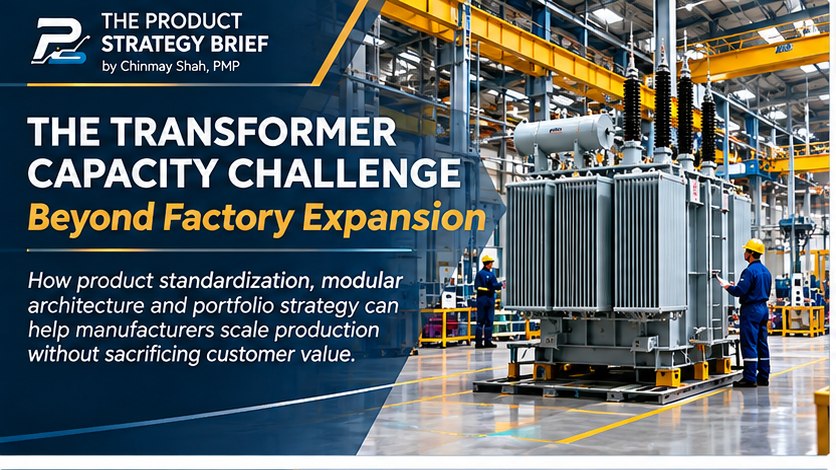
The industry’s capacity challenge is bigger than factory expansion. The transformer industry is entering a significant investment cycle. Rising electricity demand, grid modernization, renewable-energy integration, industrial electrification, and AI data-center expansion are placing increasing demands on electrical infrastructure.
Manufacturers are responding with substantial investments.
In September 2026, Hitachi Energy announced a US$528 million investment in a new transformer manufacturing facility in Gallman, Mississippi. The facility is expected to begin production in 2029 and more than double the production capacity of its existing Crystal Springs operation.
A month later, Hitachi Energy announced a CAD $479 million investment in a transformer-insulation manufacturing facility in London, Ontario. Expected to be completed in 2028, the facility will establish Canada’s first electrical insulation pressboard manufacturing line.
Hammond Power Solutions also announced a new manufacturing facility in Fort Worth, Texas, intended to support growing demand for large standard and custom-engineered transformers. Production is expected to begin in stages in late 2027.
These developments demonstrate how strategically important electrical-equipment manufacturing has become.
However, they also raise a question that deserves greater attention:
What if increasing transformer production is not only a manufacturing-capacity challenge, but also a product-portfolio and architecture challenge?
Building additional factories increases physical capacity.
But how manufacturers design, configure, and manage their product families can influence how effectively that capacity is utilized.
I believe both deserve attention.
1. Understanding the real manufacturing bottlenecks Transformers are complex engineered products requiring specialized materials, manufacturing processes, production equipment, testing infrastructure, and skilled labor. Depending on the transformer category, manufacturing constraints can emerge across several areas:
Magnetic cores: availability of electrical steel, core processing, and specialized manufacturing capabilities.
Windings: copper or aluminum supply, winding equipment, and production capacity.
Insulation systems: availability of electrical insulation materials and the processes needed to achieve dielectric performance.
Assembly: specialized production equipment, skilled workers, and manufacturing coordination.
Testing: electrical testing capabilities, equipment availability, and quality-assurance resources.
Engineering: technical resources needed to design, customize, validate, and release products.
An important example emerged in October 2026.
Hitachi Energy’s announced Ontario investment focuses on producing electrical insulation pressboard and laminates—critical components used in transformer manufacturing.
This investment addresses an upstream supply-chain capability rather than only expanding final transformer assembly.
It illustrates an important operational principle:
Adding final assembly capacity cannot fully solve a production constraint if critical materials remain unavailable.
But material availability is only one consideration.
Another potential constraint deserves attention: product complexity.
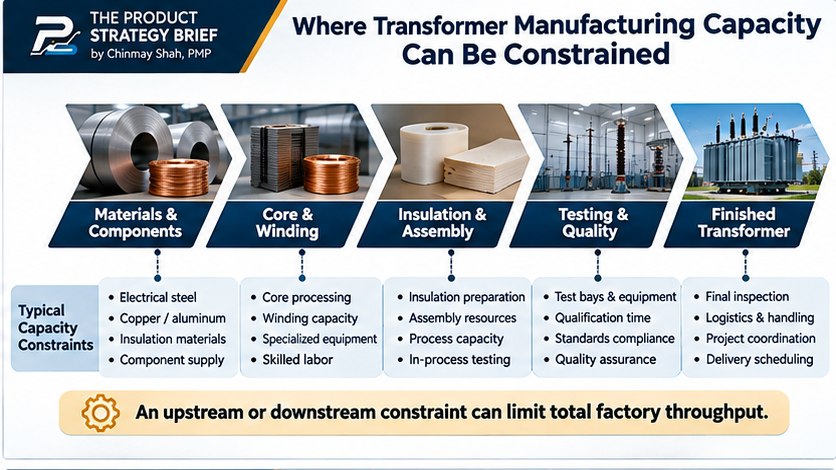
Materials & Components → Core and Winding → Insulation & Assembly → Testing & Quality → Finished Transformer
2. The hidden cost of product variety Transformer manufacturers serve customers with diverse technical, regulatory, installation, and operational requirements. Variations may include voltage ratings, winding configurations, impedance, insulation systems, cooling arrangements, enclosure designs, terminal configurations, accessories, and protection requirements.
Many of these differences are essential.
Others may result from historical practices, inconsistent specifications, or design preferences accumulated over time.
The U.S. Department of Energy identified more than 80,000 distribution-transformer varieties nationwide and reported that inconsistent utility specifications contribute to longer production times.
The number does not represent 80,000 entirely different manufacturing designs, nor does it prove that all variation is unnecessary.
However, it highlights a challenge faced by electrical-equipment manufacturers: specification diversity can increase operational complexity.
Consider a simplified example.
Two utility customers may require transformers with similar fundamental electrical performance.
One requests a specific accessory arrangement, while another requires a different mechanical configuration.
If those variations require separate engineering drawings, procurement arrangements, production instructions, and testing procedures, manufacturing complexity can increase.
The question is not whether manufacturers should eliminate customization.
It is whether every variation delivers enough customer value to justify its cost.
How much product variation creates meaningful differentiation, and how much simply adds operational complexity?
That is not only an engineering question.
It is a Product Management question.
3. Could product-family architecture improve manufacturing scalability? One potential solution is to move from managing large numbers of independently configured products toward more deliberate product-family architectures. A product-family strategy defines which elements remain common, which can vary within controlled boundaries, and which require unique engineering.
Consider a conceptual transformer product family.
Common elements Where technically feasible, manufacturers could standardize selected enclosure families, accessories, manufacturing interfaces, documentation structures, or component specifications.
Configurable elements Predefined rating ranges, terminal arrangements, tap configurations, or selected cooling options could be offered through approved configurations.
Unique elements Specialized electrical requirements, unusual installation conditions, or application-specific designs would continue to receive custom engineering.
The objective would not be to force every customer into a single standardized product.
Instead, manufacturers could develop controlled product configurations that preserve performance and customer requirements while reducing avoidable variation.
Potential benefits could include:
Greater component reuse.
Simplified procurement planning.
Reduced repetitive engineering work.
More predictable manufacturing processes.
Clearer product configuration rules.
Improved production scheduling.
Reduced inventory complexity.
These are potential benefits, not guaranteed outcomes.
Platform development requires careful validation.
A poorly designed common platform can introduce compromises in product cost, size, efficiency, reliability, or manufacturing flexibility.
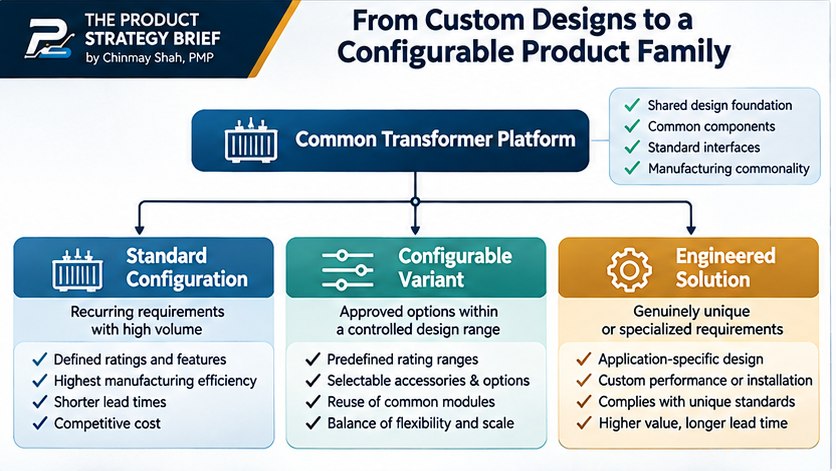
4. Applying product-family strategy to electrical equipment One of the most valuable concepts I studied through MIT Professional Education’s Designing Product Families: From Strategy to Implementation program is the importance of deliberate product architecture. The distinction between common, cousin, and unique elements provides a useful way to evaluate product complexity.
Applied to industrial electrical equipment, it raises a fundamental strategic question:
Where should manufacturers standardize to gain scale, and where should they preserve differentiation to create customer value?
For a transformer manufacturer, the answer depends on several factors:
How similar are customer requirements across applications?
Which components represent meaningful cost drivers?
Which configurations have the highest recurring demand?
What technical interfaces can realistically be standardized?
Which design variations are required by regulations or operating conditions?
How much engineering and production effort does each variation require?
This analysis must involve more than Product Management alone.
Engineering must evaluate technical feasibility.
Operations must evaluate manufacturing efficiency.
Supply chain must evaluate component availability.
Sales must understand customer requirements and willingness to accept standardized solutions.
Finance must evaluate lifecycle profitability and return on investment.
Product Management helps connect these considerations to market demand and portfolio priorities.
A technically elegant platform is not necessarily a commercially successful platform.
The right architecture must create value for customers and the manufacturer.
5. The commercial trade-off: customization versus complexity Customization has historically been an important competitive advantage in industrial markets. It allows manufacturers to support specialized equipment, demanding environments, project-specific requirements, and complex applications.
Eliminating customization indiscriminately would be a mistake.
However, customization also carries an economic cost.
A special configuration may generate additional revenue while requiring disproportionate engineering effort, procurement resources, manufacturing coordination, or testing capacity.
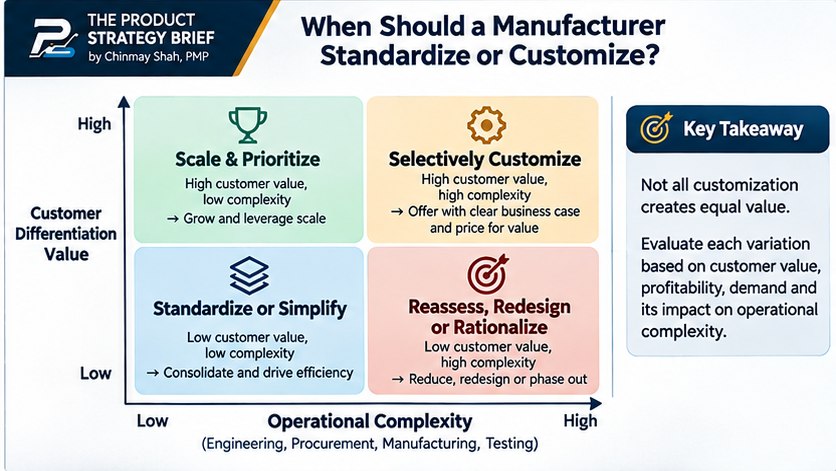
Manufacturers should therefore evaluate product variations using more than revenue alone.
A more complete assessment should consider:
Customer value: Does the variation solve an important application requirement?
Profitability: Does its contribution margin justify the added complexity?
Demand: Is the requirement recurring or limited to one project?
Manufacturing impact: Does it affect throughput, lead time, or production planning?
Strategic importance: Does it strengthen a valuable customer relationship or create a defensible market position?
Lifecycle cost: What additional support, documentation, quality, or service obligations does it create?
The goal is not necessarily to minimize the number of product variants.
It is to maximize the customer and business value created by the complexity the manufacturer chooses to support.
6. Where should transformer manufacturers invest? Current investment announcements suggest manufacturers expect sustained demand for electrical infrastructure. But investment strategy should not be limited to choosing the next factory location.
I see four complementary areas worth evaluating.
Investment 1: Physical manufacturing capacity Expand production facilities, specialized equipment, testing capabilities, and workforce resources where demand and utilization justify the investment. New factories can improve output, manufacturing flexibility, and geographic proximity to customers.
However, they require substantial capital and long implementation timelines.
Investment 2: Supply-chain resilience Strengthen access to critical components and materials through supplier development, alternative sourcing, localization, or carefully justified vertical integration. The recently announced Hitachi Energy insulation investment demonstrates the strategic importance of critical component availability.
Investment 3: Scalable product architecture Identify opportunities for common components, repeatable engineering designs, approved configurations, and better product-family governance. This approach could help reduce avoidable complexity while preserving essential differentiation.
Its value must be validated using real product and manufacturing data.
Investment 4: Digital configuration and portfolio intelligence Improve the connection between customer requirements, approved product configurations, engineering documentation, material planning, and manufacturing execution. Product configurators, integrated product data, and more consistent design rules may help reduce manual coordination and prevent avoidable configuration errors.
These investments are not mutually exclusive.
A manufacturer may need additional production capacity and better product architecture simultaneously.
The correct priorities depend on where the actual bottlenecks exist and which investments generate the strongest long-term business value.
7. What should Product Management do differently? In many industrial organizations, Product Management focuses on market analysis, product requirements, roadmaps, pricing, launches, and lifecycle decisions. Those responsibilities remain essential.
However, when manufacturing capacity becomes a strategic constraint, Product Managers should also understand how portfolio decisions influence operational scalability.
I would focus on three questions.
First: Which product variations genuinely create customer value?
Voice of Customer research, market segmentation, application requirements, sales history, and profitability analysis should help distinguish meaningful differentiation from avoidable complexity.
Second: Which product families offer the strongest opportunities for standardization?
Product Managers can work with engineering and operations to identify configurations with recurring demand, similar technical requirements, and opportunities for shared components.
Third: How should companies allocate constrained resources?
A high-revenue custom product is not necessarily the most profitable use of limited engineering or manufacturing capacity.
Equally, a standardized product with little market demand is not automatically attractive.
Good Product Management requires balancing customer value, technical feasibility, capacity utilization, and profitability.
8. My perspective: manufacturing capacity and product architecture belong in the same strategic discussion
My background spans transformer engineering, manufacturing collaboration, product lifecycle management, and product portfolio strategy.
Across those disciplines, one recurring lesson stands out:
Technical product decisions and business performance are deeply connected.
Manufacturers must constantly balance technical performance, customer requirements, customization, manufacturing scalability, delivery commitments, product cost, and profitability.
The current transformer investment cycle creates an opportunity to reconsider how these priorities are managed together.
Factory expansion is essential where physical capacity is insufficient.
Supply-chain investment is critical where specialized materials constrain production.
But manufacturers should also evaluate whether their existing product portfolios and architecture support the scale they are trying to achieve.
The strongest competitive advantage may not come from manufacturing capacity alone.
It may come from combining capacity, supply resilience, and scalable product architecture more effectively than competitors.
For Product Management leaders, this creates an opportunity to connect technical design decisions directly with manufacturing economics and long-term growth.
And that leads to the question I believe every electrical-equipment manufacturer should consider:
If you were making a major investment in transformer manufacturing today, how would you balance new production capacity, supply-chain resilience, and product-platform standardization?
References and further reading
1. Hitachi Energy — October 16, 2026 Hitachi Energy invests $479 million CAD to bring critical transformer manufacturing capability to Canada.
2. Hitachi Energy — September 15, 2026 Hitachi deepens commitment to U.S. manufacturing with $528 million Mississippi transformer factory.
3. Hammond Power Solutions — September 22, 2026 Hammond Power Solutions Increases North American Capacity.
https://americas.hammondpowersolutions.com/news/2026/september/hps-increases-north-american-capacity
4. U.S. Department of Energy, Office of Electricity DOE and Industry Team Up to Keep the Lights On for America.
https://www.energy.gov/oe/articles/doe-and-industry-team-keep-lights-america
5. U.S. Department of Energy, Office of Electricity Supply Chain and Market Analysis — Distribution Transformer Standardization.
https://www.energy.gov/oe/supply-chain-and-market-analysis
Originally published: https://www.linkedin.com/pulse/transformer-capacity-challenge-why-building-more-factories-pmp–ptbhc/. Editorial version derived from the supplied final manuscript. Please confirm visual equivalence to the live publication before release.
