
Five NPD/NPI decisions that matter more than the launch date
By Chinmay Shah
What if your product passes every engineering test—but still fails to become a profitable business?
That is one of the most important questions industrial product leaders should ask before approving a launch.
Consider a hypothetical next-generation industrial power converter. Engineering achieves the target efficiency. The prototype passes validation. Customers express interest. Leadership approves production. Then reality intervenes: manufacturing struggles with assembly consistency, a critical component has only one qualified supplier, customer-specific modifications increase complexity, and expected margins begin disappearing.
The technology works. The product business does not.
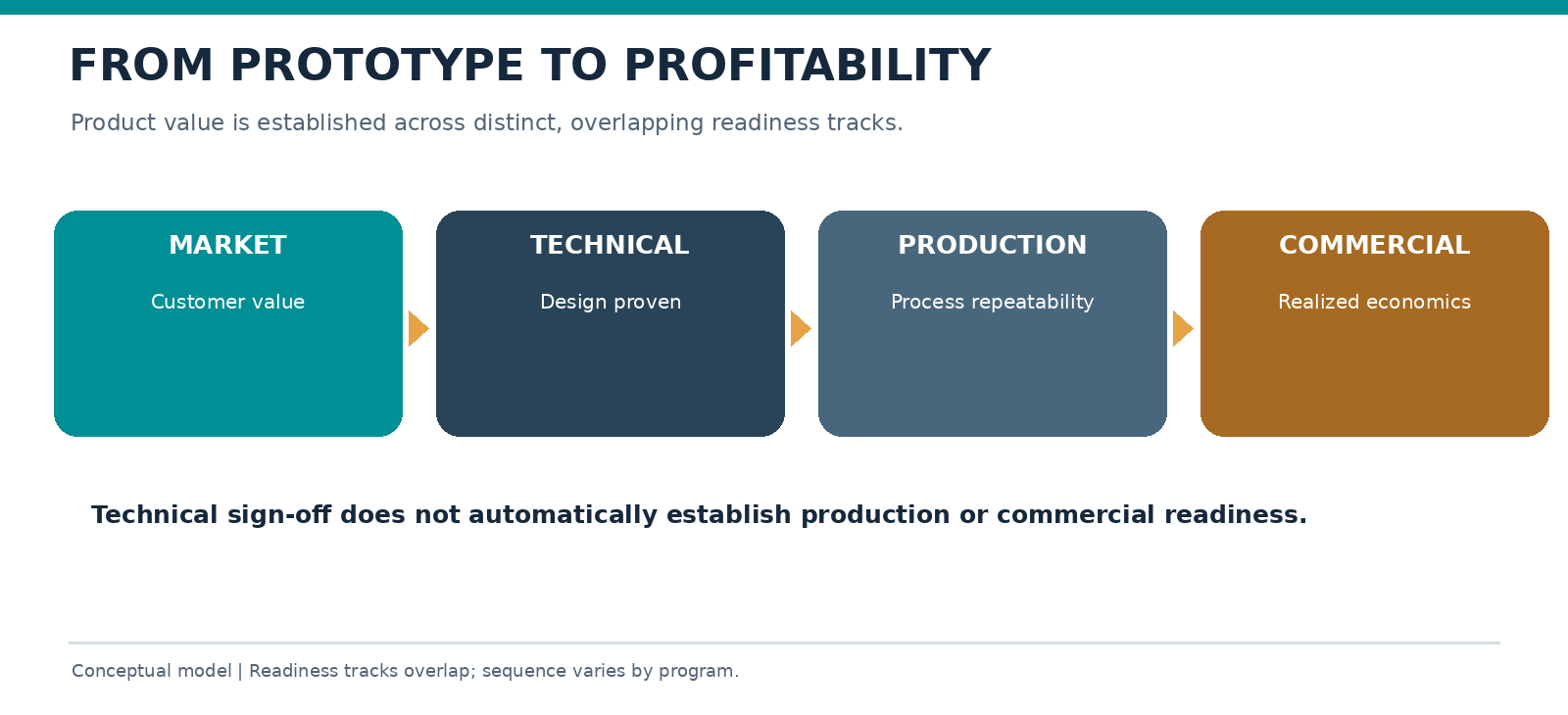
New Product Development (NPD) establishes what to develop and why customers should value it. New Product Introduction (NPI) establishes whether the organization can reliably manufacture, deliver, support, and scale it. The challenge is connecting both before committing significant resources.
1. Why the Rules Are Changing
Industrial development is under pressure from evolving technologies, customer requirements, and competitive development cycles. The International Energy Agency forecasts global electricity demand growth averaging 3.6% annually during 2026–2030, supported by industrial activity, electrification, electric vehicles, and data centers [1]. That creates opportunities across power equipment, but demand growth does not guarantee profitable products.
McKinsey reported that some newer Chinese EV manufacturers develop vehicles from concept to launch in approximately 24 months, versus 40–50 months or longer for certain established manufacturers [2]. These automotive timelines should not be treated as benchmarks for industrial transformers or switchgear. They illustrate how architecture and coordination influence competitive responsiveness.
My interpretation: the next competitive advantage will come from reducing the time between validated customer demand and profitable, repeatable delivery—not simply shortening engineering schedules.
2. Five Decisions That Determine Launch Success
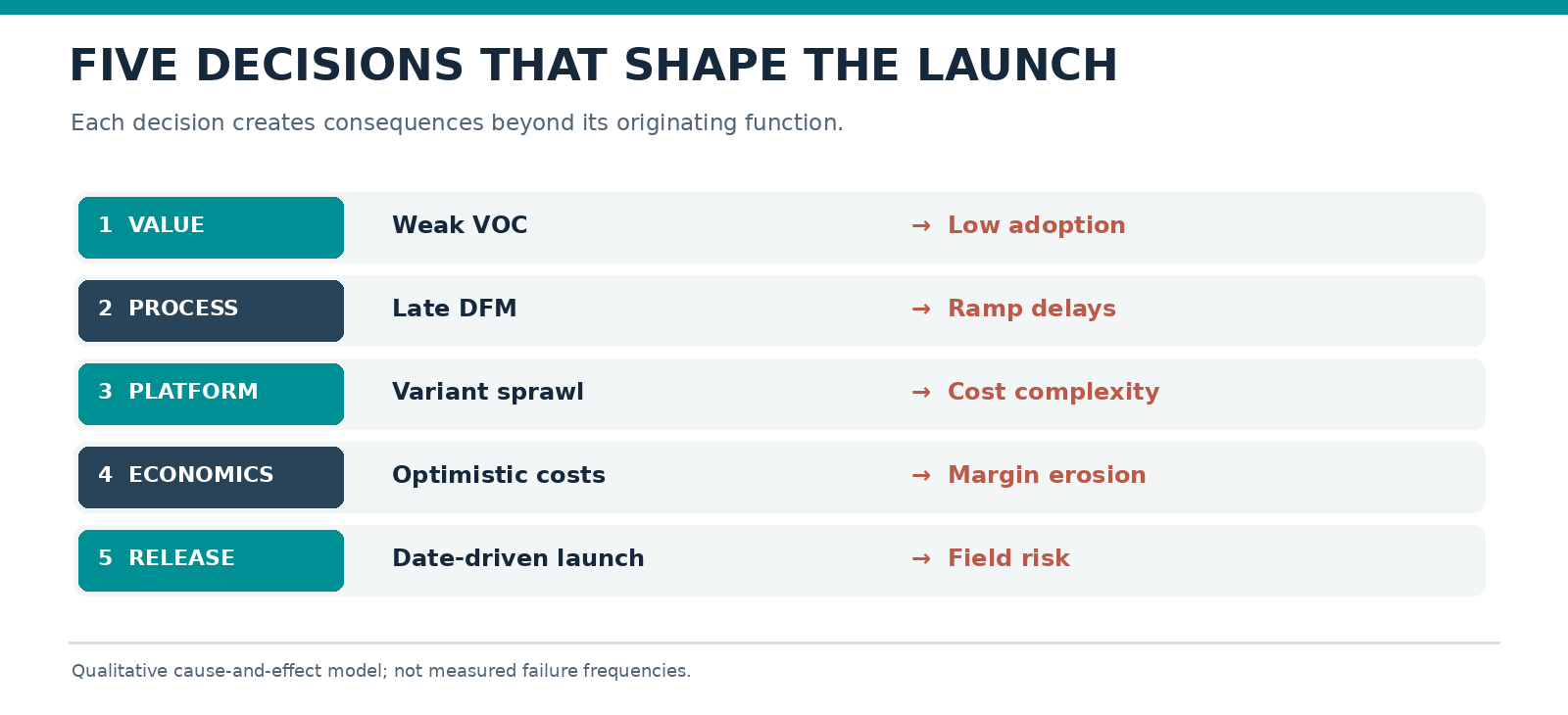
Decision 1 — Are We Solving a Valuable Customer Problem?
A roadmap can begin with exciting technology instead of a validated market need. A transformer offering higher efficiency at a premium price may create substantial lifecycle value for a continuously operated facility but deliver limited savings in an intermittent application. Identical specifications; different customer economics.
Better decision: Validate buying criteria through Voice of Customer (VOC) research, application economics, competitive alternatives, and realistic adoption assumptions before finalizing requirements.
Decision 2 — Can We Manufacture What We Designed?
A prototype assembled by experienced technicians is not proof of production readiness. It may require specialized labor, difficult tolerances, expensive testing, or processes that cannot consistently achieve intended output.
Better decision: Integrate Design for Manufacturing and Assembly (DFMA), supplier risk reviews, process capability planning, and production-representative validation before design freeze.
Decision 3 — Are We Building a Platform or Exceptions?
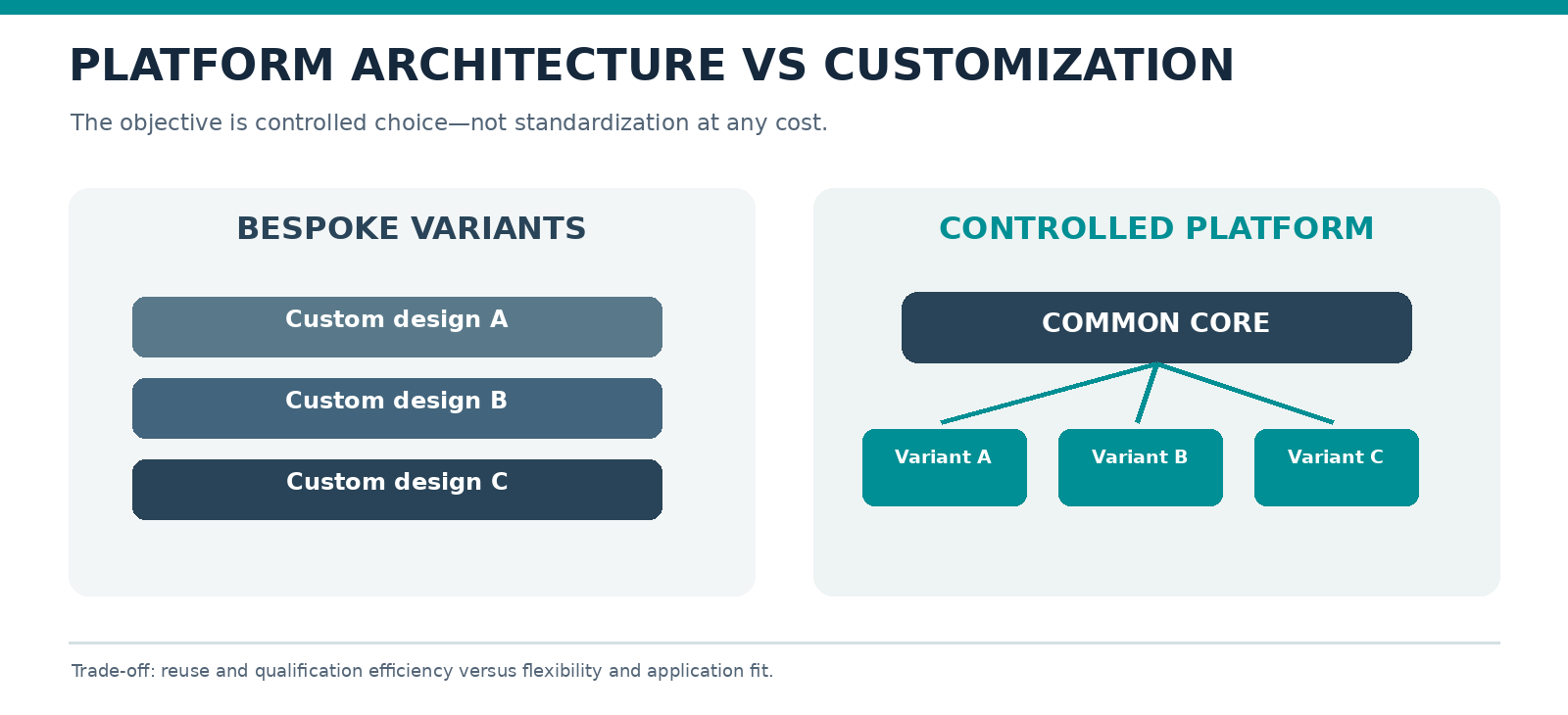
Customization is often necessary, but unmanaged variants can create unique drawings, inventory, testing, and support obligations. Standardization is not automatically superior either: a common design can sacrifice application performance or impose unnecessary cost.
Better decision: Establish common platforms where economically justified, define controlled variants, and approve exceptions against incremental profitability and strategic value.
Decision 4 — Does the Business Case Survive Production Reality?
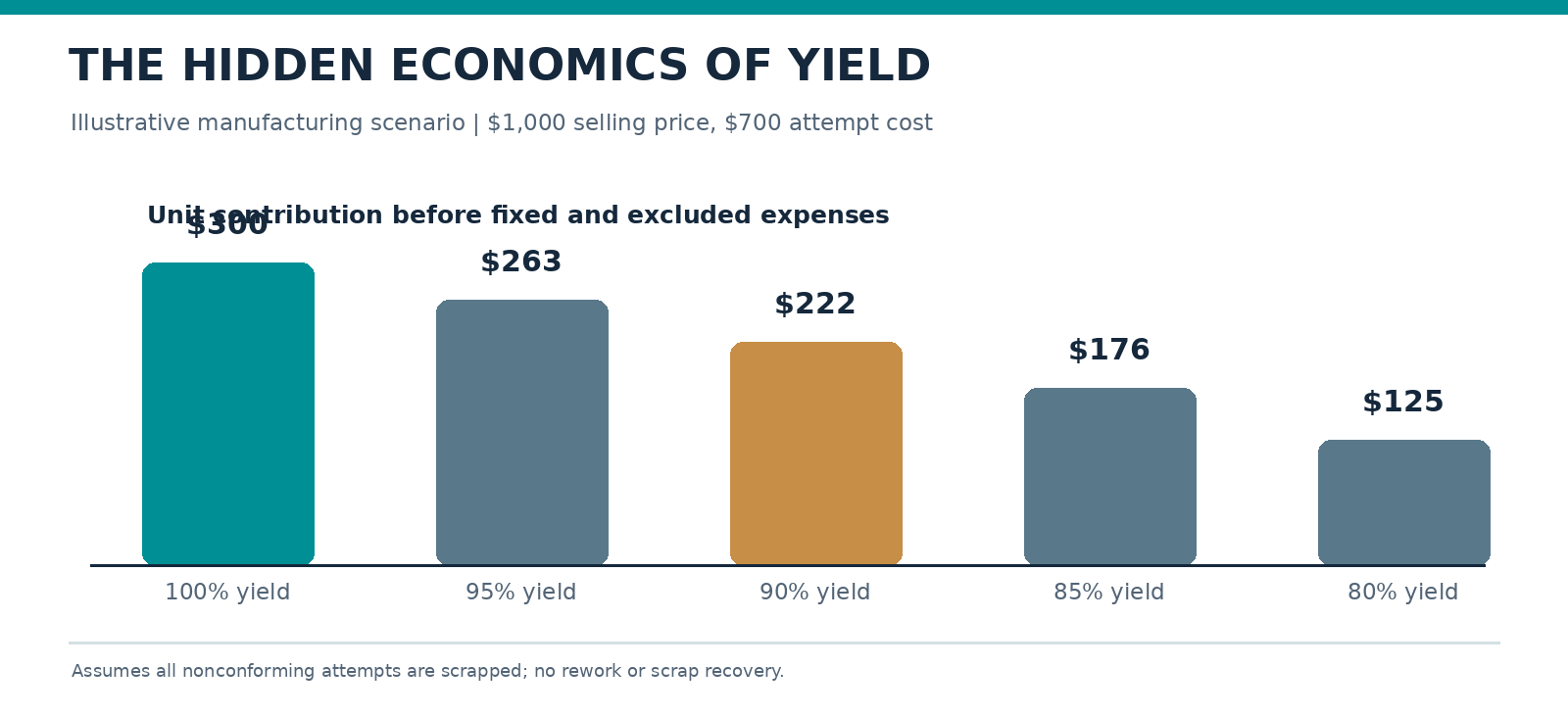
A target manufacturing cost is not an achieved cost. Consider an illustrative product selling for $1,000 per acceptable unit, costing $700 per production attempt, with 90% first-pass yield and no scrap recovery or rework. Under these simplified assumptions, each acceptable unit requires an expected 1.11 attempts. Effective variable production cost becomes approximately $778, leaving $222 of contribution before fixed and excluded expenses.
At 100% yield, the contribution would be $300. A ten-percentage-point yield difference therefore reduces modeled unit contribution by approximately 26%. This is not industry benchmark data; actual outcomes depend on defect patterns, recovery, rework, warranty, and operating economics.
Better decision: Refresh costs and margins with achieved yields, tooling, inventory, supplier pricing, warranty exposure, and realistic sales volumes.
Decision 5 — Are We Ready to Launch or Only to Announce?
Sales may want revenue. Engineering may have completed verification. Operations may lack capacity. Quality may have unresolved findings. Finance may question investment. These are legitimate but competing responsibilities, not merely communication failures.
Better decision: Separate technical release, commercial availability, and production ramp. Assign accountable decision owners and make unresolved risk visible before authorization.
3. Better NPI Does Not Mean More Bureaucracy
Manufacturers do not necessarily need another stage-gate system. AIAG’s Advanced Product Quality Planning, Third Edition, already covers sourcing, change management, risk mitigation, program metrics, and gated management [3]. The opportunity is to improve the quality of evidence within existing governance.
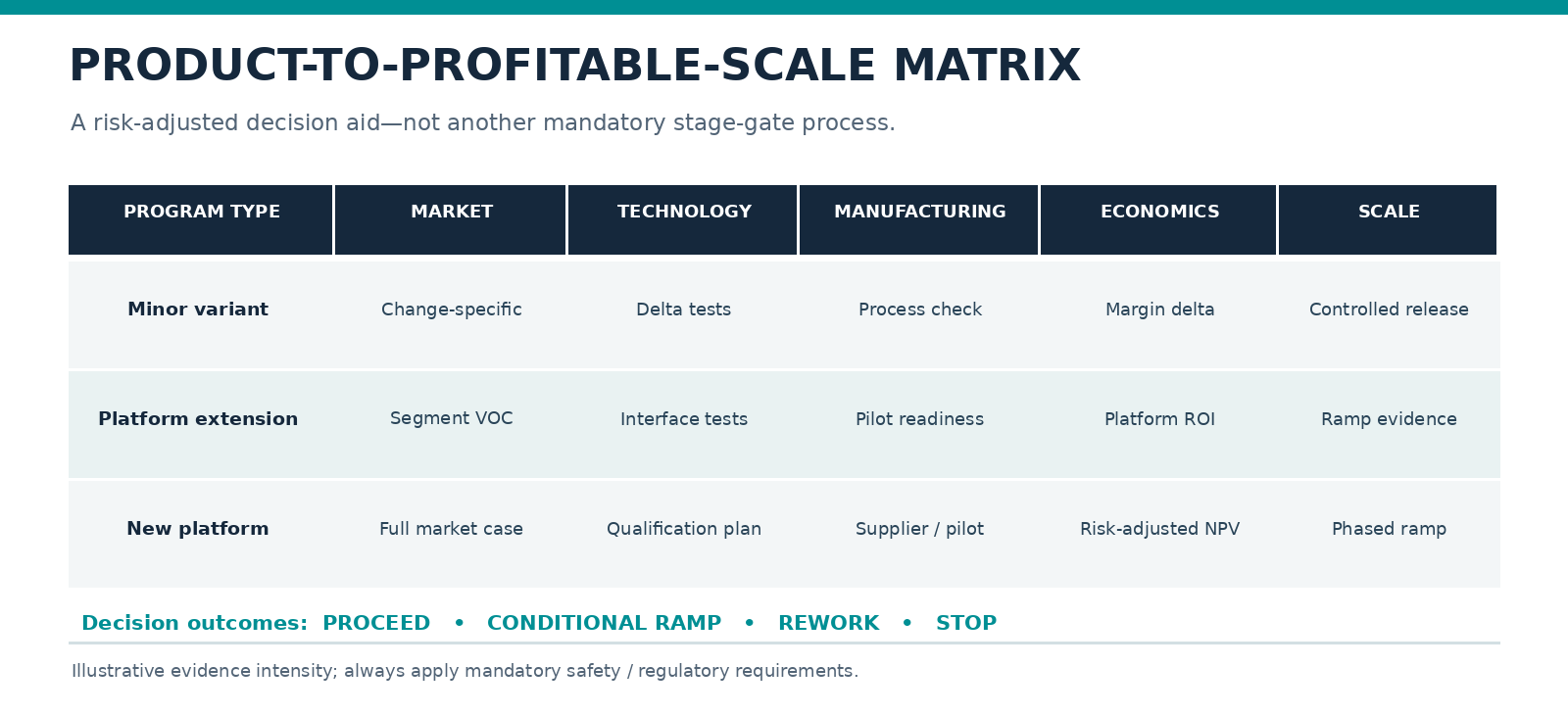
A Product-to-Profitable-Scale Decision Framework can connect five concurrent questions: Is customer value validated? Is technology verified? Can manufacturing repeat the outcome? Do economics survive realistic assumptions? Can the organization sustain scale? It is a proposed decision aid, not a validated standard or a replacement for formal APQP.
Evidence must be proportionate to product risk. A minor variant may require targeted change testing; a new platform may demand extensive qualification, supplier development, and field validation. Safety and regulatory requirements remain mandatory. Leadership can proceed, conditionally ramp, redesign, or stop investment.
4. What AI and Digital Engineering Actually Change
AI-assisted analysis, simulation, and digital-thread technologies are expanding the industrial product team’s toolkit. NIST’s smart-manufacturing roadmap identifies AI applications across manufacturing operations; its digital-thread research addresses the integration of product information from design through manufacturing and quality [4, 5].
These capabilities may expose changes, quality patterns, and process constraints earlier, but software does not automatically replace physical testing or fix weak suppliers and flawed customer assumptions. Digital initiatives require trustworthy data, integration, cybersecurity consideration, and organizational adoption.
The strategic question is which measurable development bottleneck a tool can remove—and whether the benefit justifies its cost.
5. Redefining Product-Management Success
Launch dates remain important but should not stand alone. A complete dashboard connects time-to-market with customer qualification, first-pass yield, capacity, realized contribution margin, and time-to-profitable-scale: the point at which a product achieves its intended financial contribution at a repeatable operating level.
Not every product should optimize immediate profit. A strategic platform may accept a longer payback if leaders explicitly approve the investment thesis and risk exposure.
The Real Competitive Advantage
A company does not win simply by launching faster. It wins when validated customer demand becomes repeatable, profitable delivery before the opportunity disappears.
Industrial product management must connect what customers value, what technology delivers, what operations reliably produce, and what the business can sustain. The strongest product organizations will not necessarily launch the greatest number of products; they will become better at deciding what deserves to be built, what is ready to scale, and when the economics justify moving forward.
Research References
[1] International Energy Agency, Electricity 2026, Executive Summary (2026).
[2] McKinsey & Company, Automotive Product Development: Accelerating to New Horizons (2025).
[3] Automotive Industry Action Group, Advanced Product Quality Planning, Third Edition (2024).
[4] NIST, 2026 Roadmap on Artificial Intelligence and Machine Learning for Smart Manufacturing.
